
Solar Cost FAQ
Is a lower price per watt always a better deal?
No. Price per watt measures panel size, not energy, so a system that costs a bit more per watt but produces more each year can cost less per kWh.
What is a DC-to-AC ratio?
It's the panel (DC) capacity compared to the inverter (AC) capacity. It's almost always above 1 to 1. Systems designed to avoid clipping usually run 1.1 to 1 up to 1.3 to 1, while a high ratio, which we often recommend, is over 1.5 to 1 and up to 2 to 1.
Isn't clipping lost energy?
Only at the very peak. A higher ratio adds more production in the mornings and afternoons than it clips at midday, and with a battery, the clipped energy can be stored for the evening.
Why do ground mounts and trackers cost more per watt?
The racking and foundations cost more, but they can produce more per panel, which can make them competitive, or better, on price per production.
Why Price per Watt Doesn't Tell the Whole Story
The solar industry prices almost everything in dollars per watt, so when you get a quote, including from us, the cost is usually divided by the size of the system in watts. It's a handy rule of thumb, but it's an old one, and it leaves out what you're actually paying for: the energy your system produces.
Below, we explain why price per watt falls short and what homeowners, businesses and farms should compare instead.
What "Per Watt" Actually Measures
The "watts" in price per watt are the nameplate rating of the solar panels. That's DC power, the kind panels produce, not the power your home or business actually uses.
DC isn't AC. Your inverters turn the panels' DC power into AC power, which is what runs your lights and equipment and what gets sent back to the grid. Most systems have more DC panel capacity than AC inverter capacity, with a ratio almost always above 1 to 1. A typical system designed to avoid clipping runs about 1.1 to 1 up to 1.3 to 1, so a price per DC watt doesn't tell you much about the AC power you'll get.
Not every watt produces the same. A ground mount can face due south at the ideal tilt, and a dual-axis tracker follows the sun all day. Most roofs don't face due south at the perfect angle, so the same number of panels can produce more energy on the ground, and more still on a tracker.
Two Numbers That Matter More: Production per Watt and Price per Production
Production per watt is the average energy a system produces in a year for each DC watt of panels installed. Think of it as how efficiently the whole system turns panel capacity into energy, including how well it faces the sun. It's higher for ground mounts and trackers than for most roof systems, because they can point the same panels at the sun more directly.
Price per production ties that efficiency to dollars: what you pay for each kilowatt-hour (kWh) the system will produce in a year. This is the number we suggest using to compare quotes. When someone, including us, says a roof mount costs less than a ground mount, we're talking about price per watt, which doesn't reflect the energy you actually get. A system with higher production per watt can cost more per watt and still cost less per kWh.
A Simple Example (hypothetical numbers)
These numbers are made up to show the math. They are not Trifecta pricing or a production estimate for any site.
- System A, a 10 kW (DC) roof mount, costs $25,000, which is $2.50 per watt. It produces about 10,600 kWh a year, so it costs about $2.36 per kWh of yearly production.
- System B, the same 10 kW as a south-facing ground mount, costs $28,000, which is $2.80 per watt. It produces about 12,500 kWh a year, so it costs $2.24 per kWh of yearly production.
Per watt, the ground mount looks 12% more expensive, but per kWh of yearly production it costs about 5% less, so it's the better buy.
Clipping: Not the Problem It Looks Like
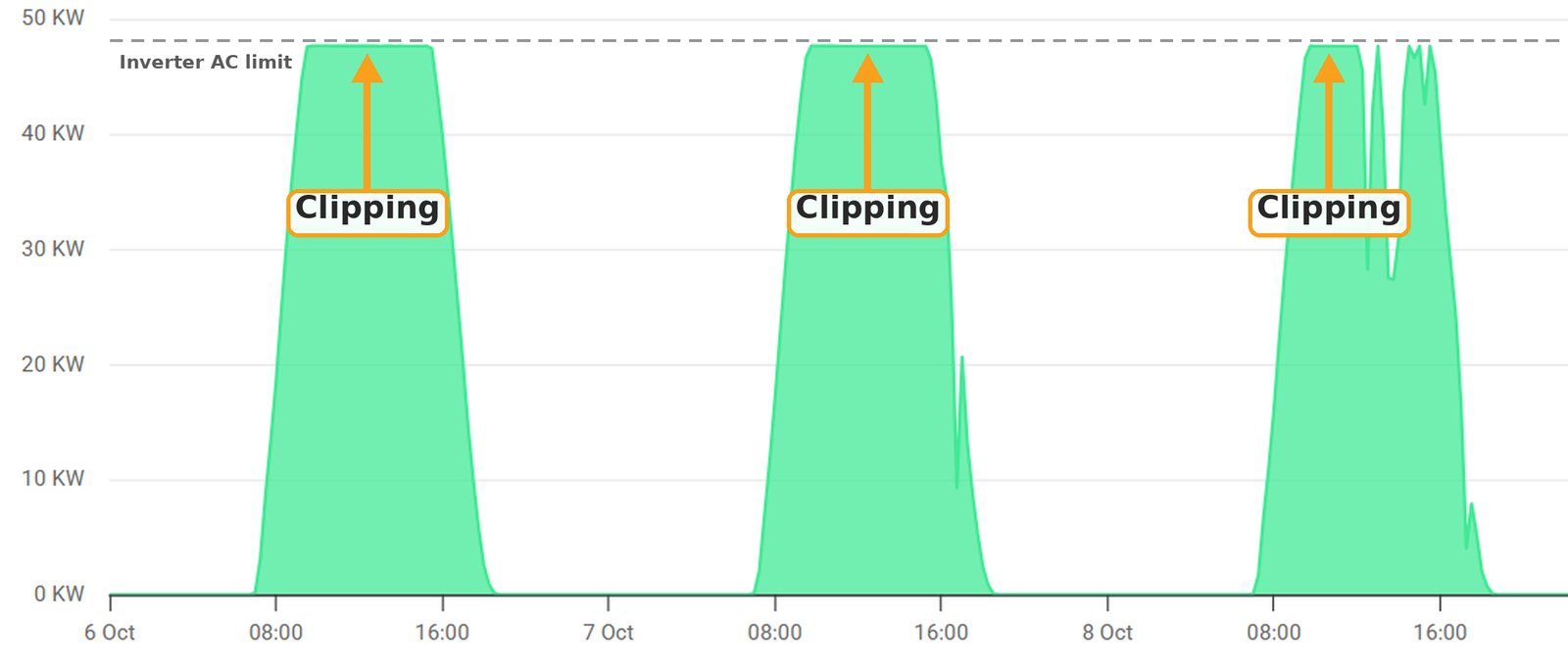
Clipping happens when the panels produce more DC power than the inverter can convert to AC, so the inverter runs at its maximum and the extra DC is "clipped." On your monitoring app, it shows up as a flat top on a sunny day's graph.
Many people see that as lost production and try to avoid it, but we look at it another way. If you value DC production most, clipping looks like waste. The inverter's AC output, though, is what you actually use and send to the grid, so if you value AC production, clipping isn't a problem. In fact, if you're never clipping, you're leaving AC capacity unused that you paid for.
Don't look at the flat peak of your daily graph. Look at the negative space: the morning and afternoon hours when your inverters aren't producing the power they could. A higher DC-to-AC ratio fills in that space and widens the shoulders of your daily solar graph, so the same inverter produces more energy over a year.
It also makes sense over time. Panel prices have generally come down while inverters and power electronics have stayed about the same, so it usually pays to make the most of the inverter capacity, and add panels to fill it.
Clipping, Batteries and Your Evening Peak
With a hybrid inverter and a battery, the extra DC power that would have been clipped can go straight into the battery. The battery sends it back out toward the end of the day as the sun falls off, covering the evening hours when people get home and use the most power. This is called peak shifting, and our battery page explains how it works.
Your Transformer Limit
The utility transformer that serves your property can limit how much AC inverter power you can install, and while the utility can upgrade the transformer, that's an added expense. Keeping AC inside the transformer limit while going higher on DC, and clipping on purpose, fills out your AC production, so you generate more energy each year on the same size inverter. It's often cheaper to pay for a higher DC-to-AC ratio than to upgrade the transformer.
That's why we're not afraid of high DC-to-AC ratios, over 1.5 to 1 and up to 2 to 1, and often recommend them. Our dual-axis trackers do something similar, keeping inverters near full output for a much longer part of the day, and none of that extra value shows up in price per watt.
Comparing Quotes
- Ask for the estimated annual production (kWh), not just the system size.
- Divide the price by the annual production to compare price per production.
- Look at the DC and AC sizes and the ratio between them.
- Consider orientation, tilt and shade, which change production more than the price per watt shows.
Paying for a system? See solar financing. Want to know how exported power is credited? See net metering.
We'll show you the price and the expected production for each option. Request a solar assessment or call us at 877-345-2470.
Solar Cost FAQ
Is a lower price per watt always a better deal?
No. Price per watt measures panel size, not energy, so a system that costs a bit more per watt but produces more each year can cost less per kWh.
What is a DC-to-AC ratio?
It's the panel (DC) capacity compared to the inverter (AC) capacity. It's almost always above 1 to 1. Systems designed to avoid clipping usually run 1.1 to 1 up to 1.3 to 1, while a high ratio, which we often recommend, is over 1.5 to 1 and up to 2 to 1.
Isn't clipping lost energy?
Only at the very peak. A higher ratio adds more production in the mornings and afternoons than it clips at midday, and with a battery, the clipped energy can be stored for the evening.
Why do ground mounts and trackers cost more per watt?
The racking and foundations cost more, but they can produce more per panel, which can make them competitive, or better, on price per production.

Have Questions? Call us at 877-345-2470
We want to ensure you are well-informed about our product line and how it can save you money on your monthly energy bills.