
Battery Storage
What a home battery is
A home battery (or "Energy Storage System" - ESS) stores electricity so you can use it when you need it most: after the sun goes down, when power costs the most, or when the grid goes out. Paired with solar, it can let your home keep running on your own power through an outage.
Today's home batteries are compact, sealed cabinets that mount on a wall or stand on the floor, indoors or outdoors. Most use lithium iron phosphate (LFP) chemistry, known for long life and safety. There is no fuel to store, no exhaust, no noise, and no routine maintenance.
A battery can do four jobs for you:
- Backup power when the grid goes down, with a backup gateway installed
- Peak shifting, using stored energy when electricity is most expensive
- Self-consumption, using more of your own solar power instead of sending it to the grid
- More solar on the same service, capturing extra production that would otherwise be lost
How a home battery works
Your solar panels and your battery both work in DC power, while your home runs on AC. An inverter converts between the two. Some systems use one hybrid inverter that handles both the solar and the battery. Others pair the battery with its own inverter, connected alongside an existing solar system. Either way, the battery charges from solar power your home isn't using right now, then discharges when your home needs it.
Two numbers describe what a battery can do:
- Capacity (kWh) is how much energy it holds, which sets how long it can run your home. A battery with 10 kWh of usable capacity could run 1 kW of essential loads for about 10 hours, or a 5 kW load for about 2 hours.
- Power (kW) is how much it can deliver at once, which sets what it can run at the same time. Motors such as well pumps and central air conditioners also need a short burst of extra power to start.
Most home batteries are modular, so capacity can be sized to your needs and often expanded later. A monitoring app shows how full the battery is, what it is powering, and how much charge to hold in reserve for an outage.
Backup power
Solar panels alone will not power your home during an outage, even on a sunny day. Grid-tied solar inverters are required to shut down when the grid goes down. This is called anti-islanding, and it protects utility line workers from power being fed back into lines they expect to be dead.
The backup gateway
To run your home during an outage, the system needs a backup gateway. Manufacturers call it a backup interface, gateway, or system controller, and the electrical code calls it a microgrid interconnect device. Whatever the name, it does the same job:
- It sits between your utility meter and your home's electrical panel.
- When it senses the grid has failed, it automatically disconnects, or islands, your home from the grid.
- With your home safely isolated, the battery and solar panels power your home.
- When grid power returns and is stable, it reconnects your home and the battery recharges.
Depending on the system, the switchover is seamless or takes a few seconds. A battery without a gateway can still do peak shifting and self-consumption, but it cannot back up your home.
Whole-home or essential loads
Whole-home backup puts the gateway at your main electrical service, so every circuit stays powered. You manage what runs, and load controllers can automatically switch off large loads like an EV charger, water heater, or air conditioner.
Essential loads backup moves the circuits that matter most to a separate backed-up panel: refrigerator, well pump, garage doors, furnace blower, lights, internet, and a few outlets. A smaller battery goes further this way.
Solar keeps working in an outage
With a gateway in place, your solar panels keep producing during an outage and recharge the battery each day. In good weather, with sensible use, a solar and battery system can carry your home through a multi-day outage. Short winter days and cloudy stretches mean less recharge, so we size the system with Pennsylvania weather in mind.
Peak shifting, self-consumption, and more solar
Peak shifting means storing energy when it is plentiful or cheap and using it when it is expensive. On a time-of-use rate, the utility charges more during peak hours, usually late afternoon and evening, just as solar production is falling off. A battery charged by your midday solar covers those peak hours, so you buy less power at the highest price.
Self-consumption works the same way without a special rate: the battery stores your surplus solar during the day and you use it at night, instead of exporting it and buying power back later. This is still beneficial, because your savings no longer depend on how your utility credits exported power, now or if net metering rules change.
How much a battery saves depends on your rate plan. On a time-of-use rate, peak shifting can justify a battery on its own, with or without backup. Many homeowners also simply prefer to run on their own solar power rather than the grid's. For businesses and farms billed on peak demand, a battery can trim demand charges, which is called peak shaving.
More solar without a costly upgrade
A battery storage system also lets you install more solar than your grid connection could otherwise handle. Panels can be sized larger than the inverter's AC output, called a higher DC-to-AC ratio. Normally, midday production beyond that limit is clipped and lost.
With a battery-ready hybrid inverter, the battery soaks up that surplus instead, while the system's output stays within your interconnection limit or the capacity of the utility transformer serving your property. That can mean a larger solar system without paying for a transformer or service upgrade needed only for the solar. The stored energy is then used in the evening like any other battery power.
Utility battery programs
Some utilities pay homeowners to let the grid draw on their batteries during times of peak demand. PPL Electric Utilities' Optimized Battery program(opens in new tab) is open to customers with a compatible home battery, with or without solar. During peak summer and winter weekday hours, the program briefly uses some of your stored energy to offset your home's use from the grid, and the battery recharges the same day. PPL never fully discharges your battery, and outside those hours it runs on your own settings. We can help you see whether your utility offers a program and whether your battery qualifies.
We'll review your bills, rate options, and site to show what a battery can do for you.
Adding a battery to existing solar
You don't need a new solar system to add a battery. How we add one depends on what you have:
- Battery-ready (hybrid) inverter: Many recent systems were installed with an inverter designed to accept a battery later. We can often add a compatible battery and backup gateway without replacing major equipment.
- Microinverter system: A battery with its own inverter can connect on the AC side of your home and work alongside your existing panels.
- Older string inverter: We can add a battery with its own inverter, or replace the inverter with a battery-ready model. Replacing it often makes sense if your inverter is nearing the end of its life.
We'll check your equipment, your electrical panel's capacity, and your utility's requirements, then handle the permit and any utility paperwork. A battery can also be installed without solar to provide backup from grid power, though it can't recharge during a long outage.
Where your battery goes
Home batteries are built for a range of locations. The most common are:
- Outside on an exterior wall: Keeps the battery out of your living and storage space. Outdoor-rated units are sealed against weather and manage their own temperature.
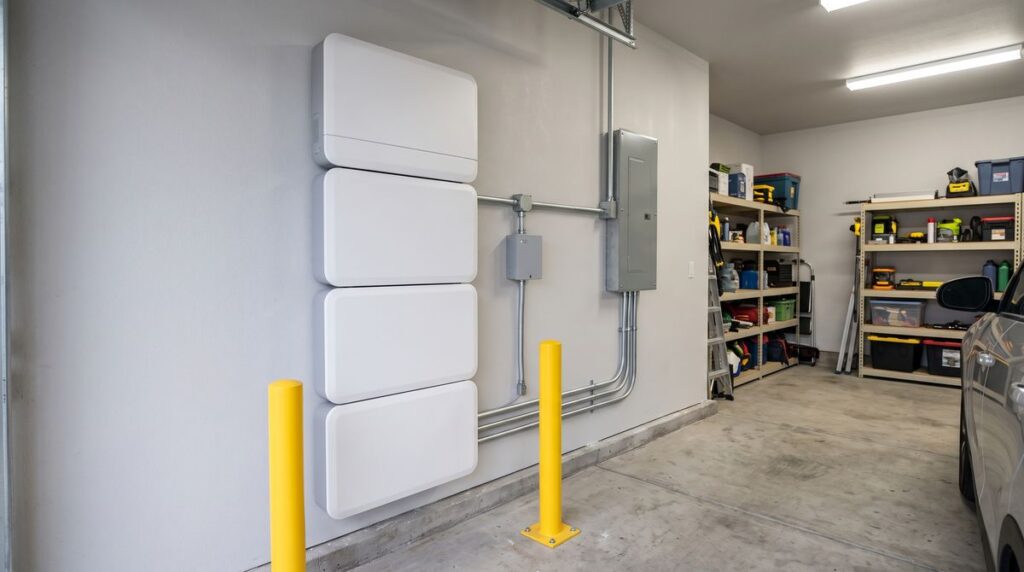
- In the garage: Protected from weather and usually close to the main panel. A bollard can be added for protection from vehicles.
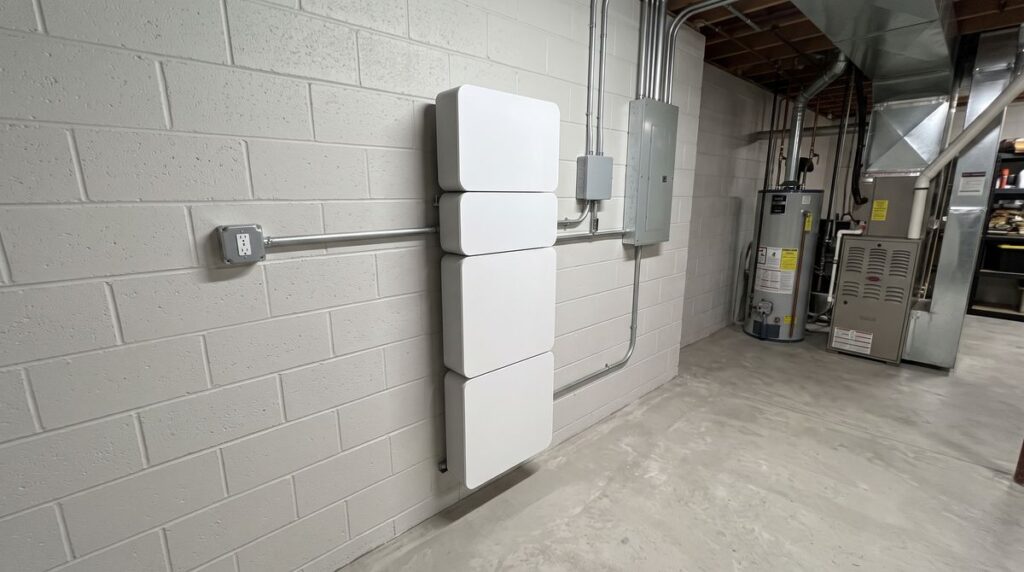
- In the basement or utility room: Conditioned space is easy on a battery, and basements are often where the main panel already is. We mount it above any flood risk, and some batteries are even rated for submersion to a certain depth.
Building and fire codes set where batteries may go, how much capacity each location can hold, and required clearances. Batteries never go in bedrooms or living spaces. We design every installation to meet code and to keep wiring runs short and clean.
Sizing your battery
The right battery depends on what you want it to do. We start with a few questions:
- What has to stay on in an outage? A sump pump, well pump, or medical equipment changes the design.
- How long are your typical outages, and how often do they happen?
- How do you heat your home? A gas furnace needs only its blower, while a heat pump or electric heat draws much more.
- Do you charge an EV, and do you want to keep charging during an outage?
- What rate plan are you on, and are you interested in time-of-use rates?
We review your past year of electric use, design a system around your answers, and handle the permit, installation, utility paperwork, and app setup. We install batteries from leading manufacturers and match them to your existing equipment.
Already have solar? We add batteries to existing systems; see solar panel service and repair. Learn how stored energy fits with Pennsylvania net metering, or explore plug-in solar.
Ready to talk about backup power? Contact Trifecta Solar for a battery consultation.

Have Questions? Call us at 877-345-2470
We want to ensure you are well-informed about our product line and how it can save you money on your monthly energy bills.