
Ground-Mounted Solar FAQ
Does a ground mount cost more than a roof mount?
Per watt, usually yes. The panels and electrical cost about the same, but the racking costs more because it's a full structure anchored in the ground. That's partly offset by simpler inverter equipment, and a ground mount facing due south at the ideal tilt can produce more per panel, so the price for each kWh produced can be close, or better. See price per watt vs. price per kWh.
How much space do I need?
It depends on the system size. Bring your electric bills to the site visit and we'll lay out the footprint for you.
How far from the house can it go?
Often farther than people expect. We usually run high-voltage DC from the array to inverters near your meter, which keeps losses and wire size down. Runs of 500 feet or more are possible.
Can I still graze or farm the land?
Yes. The structures are normally fine with animals around them, including sheep, and the space between rows can be used for grazing or crops. This is called agrivoltaics.
GROUND-MOUNTED SOLAR PANELS
When a Ground Mount Beats the Roof
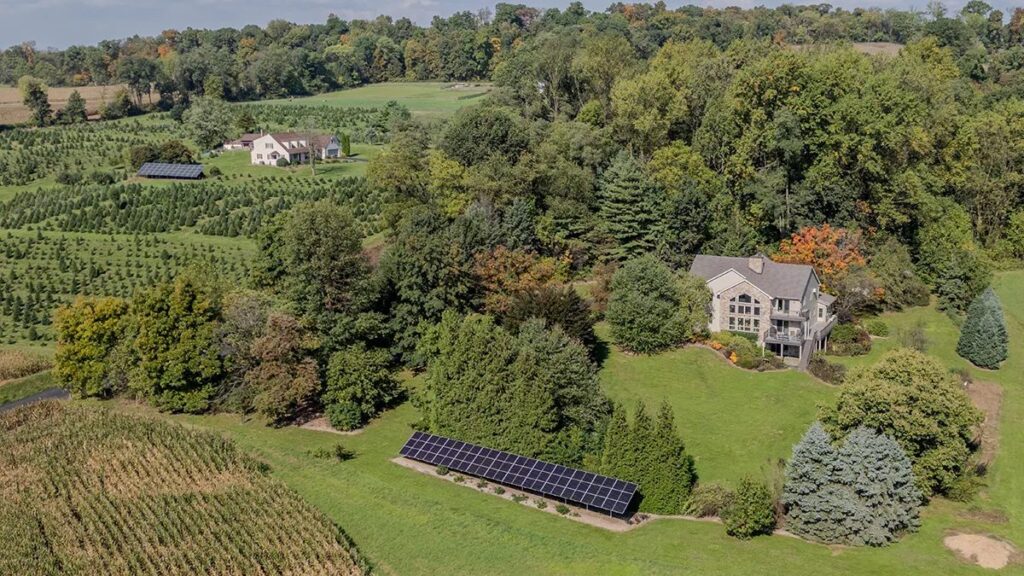
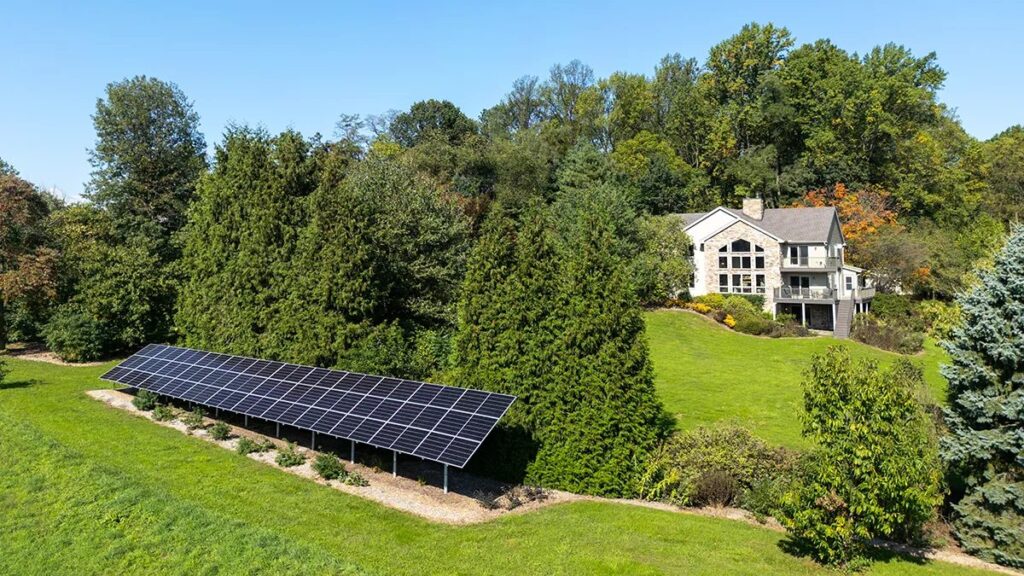
For a lot of homes, businesses and farms across Pennsylvania, the best place for solar isn't the roof. If you have open yard, a field or pasture, a ground-mounted system lets us put the panels where the sun is instead of where the roof happens to be.
A ground mount can make more sense when:
- Your roof is shaded, faces the wrong way, or doesn't have enough usable space.
- Your roof is older, or you'd rather not have anything attached to it.
- You need a bigger system than the roof can hold, such as for a farm, shop or barn.
- You want the panels easy to reach for cleaning, snow and service.
If your roof is a good fit, roof-mounted solar is usually simpler and lower cost. If you want the most production out of a given footprint, a dual-axis tracker follows the sun through the day. We'll show you the options that fit your property.
What a Ground Mount Costs
The panels, electrical work and disconnects cost about the same on the ground as on a roof. The racking costs more, because a ground mount is a complete support structure anchored to the ground and framed on site, not a set of rails screwed to a roof.
Some of that is made up in other places. Ground mounts typically don't have a rapid-shutdown requirement, and they generally aren't put in shaded spots, so we can usually use string inverters without optimizers or rapid-shutdown devices. Where possible, we also face the array due south at the ideal tilt for your location. Most roofs don't face due south at the perfect angle, so each panel on a ground mount can produce more. It's the same idea as a dual-axis tracker, to a lesser degree.
Because of that extra production, price per watt understates what a ground mount is worth. A ground mount can cost more per watt and still cost less for each kWh it produces over its life. See price per watt vs. price per kWh.
Picking the Spot
Sun and orientation. On the ground, we can usually face the array south at the ideal tilt for your location, which can produce more over a year than a roof that's off-angle. East- or west-facing arrays can also work when that's what the site allows.
Distance and trenching. The wiring from the array runs underground in conduit to the building with your electric meter. We usually put the inverters at or near that building, so the long run from the array carries DC power at a higher voltage. Higher voltage loses less power over distance and can use smaller wire, which keeps long runs affordable. On larger farm and business arrays with 3-phase service, especially 480V, the system can run at even higher DC voltage, up to about 1000 volts, which allows even longer runs. Runs of 500 feet or more are possible, so the array can usually go in the sunniest spot on your property. We'll walk the site with you and look at driveways, septic systems, wells, buried lines and anything else in the way.
Foundations. Around here we normally anchor ground mounts with ground screws. If the soil, rock or site calls for it, we use concrete footings or other foundations instead.
Living With a Ground Mount
Ground clearance. The panels sit high enough to stay up out of the grass and weeds.
Animals and crops. Ground-mount structures are normally fine with animals around them, including sheep. Using the same land for solar and farming is called agrivoltaics, and the space between ground-mount rows can be ideal for grazing or crops.
Wiring. All the wiring to the array runs underground in conduit. The cabling at the panels themselves isn't fully enclosed, so if animals ever damage it, our service team can repair it and add critter guard where it helps.
Warranties. Every system we install is backed by our 10-year workmanship and labor warranty, on top of the manufacturer warranties on the equipment. Many equipment makers also offer extended manufacturer warranties, and optional third-party warranties are available for extra coverage. See our solar warranty page for the details.
Service and repair. We're local. We also service and repair existing systems, including ones we didn't install.
Solar Carports
A solar carport is a ground mount raised high enough to park under. The panels sit on a sturdy steel frame, so the same structure that makes your power also shades your vehicles and keeps rain, snow, hail and summer sun off them. Carports come in sizes from a single parking space up to four cars, and they cost a bit more than a standard ground mount because of the taller frame. For many homeowners the trade is worth it: you get clean energy and a covered spot for cars, a tractor or other equipment, all from the same footprint.
Solar for Farms and Agricultural Land
Barns, dairies, poultry houses and shops use a lot of power, and most farms have ground to spare. A ground mount on a corner of a field or along a fence line can offset a big part of a farm's electric bill without touching the barn roof, and the land between rows can still be grazed or farmed. USDA REAP grants may be available for farm and rural business projects, but these programs keep changing, so we'll check what's current for your project. See agricultural solar for more on farm projects.
Permits and Setbacks
Ground mounts are permitted through your township. Many townships have setbacks from property lines and roads, height limits, and in some cases zoning or stormwater rules for larger arrays. We check the rules for your township during design and handle the permits and the utility interconnection application.
What the Install Looks Like
- Site visit and design. We walk the property, look at your electrical panel and recent electric bills, and pick the array location with you. Then we design a system and give you a proposal.
- Permits and utility application. We file the township permits and the interconnection application with your utility.
- Foundations and racking. We set the foundations and build the racking.
- Trenching and wiring. We trench from the array to your panel or meter, then run and connect the wiring.
- Panels and inspection. Panels go on, the system is inspected, and the utility gives permission to operate. From signing to turning the system on, permits and utility approvals often take a few months. We keep you updated along the way.
Net Metering and Your Bill
With net metering, extra power your array produces during the day goes out to the grid and shows up as a credit on your bill. Our net metering guide walks through how the credits work.
Adding a Battery
A grid-tied system on its own shuts off during an outage. If you want backup power, a battery can be added now or later. See solar battery storage and backup power.
Walk Your Property With Us
Not sure where an array would go? Request a solar assessment or call us at 877-345-2470. We'll walk the site and tell you honestly whether a ground mount, a roof mount, or a tracker makes sense for your home, business or farm.
When a Ground Mount Beats the Roof
For a lot of homes, businesses and farms across Pennsylvania, the best place for solar isn't the roof. If you have open yard, a field or pasture, a ground-mounted system lets us put the panels where the sun is instead of where the roof happens to be.
A ground mount can make more sense when:
- Your roof is shaded, faces the wrong way, or doesn't have enough usable space.
- Your roof is older, or you'd rather not have anything attached to it.
- You need a bigger system than the roof can hold, such as for a farm, shop or barn.
- You want the panels easy to reach for cleaning, snow and service.
If your roof is a good fit, roof-mounted solar is usually simpler and lower cost. If you want the most production out of a given footprint, a dual-axis tracker follows the sun through the day. We'll show you the options that fit your property.
What a Ground Mount Costs
The panels, electrical work and disconnects cost about the same on the ground as on a roof. The racking costs more, because a ground mount is a complete support structure anchored to the ground and framed on site, not a set of rails screwed to a roof.
Some of that is made up in other places. Ground mounts typically don't have a rapid-shutdown requirement, and they generally aren't put in shaded spots, so we can usually use string inverters without optimizers or rapid-shutdown devices. Where possible, we also face the array due south at the ideal tilt for your location. Most roofs don't face due south at the perfect angle, so each panel on a ground mount can produce more. It's the same idea as a dual-axis tracker, to a lesser degree.
Because of that extra production, price per watt understates what a ground mount is worth. A ground mount can cost more per watt and still cost less for each kWh it produces over its life. See price per watt vs. price per kWh.
Picking the Spot
Sun and orientation. On the ground, we can usually face the array south at the ideal tilt for your location, which can produce more over a year than a roof that's off-angle. East- or west-facing arrays can also work when that's what the site allows.
Distance and trenching. The wiring from the array runs underground in conduit to the building with your electric meter. We usually put the inverters at or near that building, so the long run from the array carries DC power at a higher voltage. Higher voltage loses less power over distance and can use smaller wire, which keeps long runs affordable. On larger farm and business arrays with 3-phase service, especially 480V, the system can run at even higher DC voltage, up to about 1000 volts, which allows even longer runs. Runs of 500 feet or more are possible, so the array can usually go in the sunniest spot on your property. We'll walk the site with you and look at driveways, septic systems, wells, buried lines and anything else in the way.
Foundations. Around here we normally anchor ground mounts with ground screws. If the soil, rock or site calls for it, we use concrete footings or other foundations instead.
Living With a Ground Mount
Ground clearance. The panels sit high enough to stay up out of the grass and weeds.
Animals and crops. Ground-mount structures are normally fine with animals around them, including sheep. Using the same land for solar and farming is called agrivoltaics, and the space between ground-mount rows can be ideal for grazing or crops.
Wiring. All the wiring to the array runs underground in conduit. The cabling at the panels themselves isn't fully enclosed, so if animals ever damage it, our service team can repair it and add critter guard where it helps.
Warranties. Every system we install is backed by our 10-year workmanship and labor warranty, on top of the manufacturer warranties on the equipment. Many equipment makers also offer extended manufacturer warranties, and optional third-party warranties are available for extra coverage. See our solar warranty page for the details.
Service and repair. We're local. We also service and repair existing systems, including ones we didn't install.
Solar for Farms and Agricultural Land
Barns, dairies, poultry houses and shops use a lot of power, and most farms have ground to spare. A ground mount on a corner of a field or along a fence line can offset a big part of a farm's electric bill without touching the barn roof, and the land between rows can still be grazed or farmed. USDA REAP grants may be available for farm and rural business projects, but these programs keep changing, so we'll check what's current for your project. See agricultural solar for more on farm projects.
Permits and Setbacks
Ground mounts are permitted through your township. Many townships have setbacks from property lines and roads, height limits, and in some cases zoning or stormwater rules for larger arrays. We check the rules for your township during design and handle the permits and the utility interconnection application.
What the Install Looks Like
- Site visit and design. We walk the property, look at your electrical panel and recent electric bills, and pick the array location with you. Then we design a system and give you a proposal.
- Permits and utility application. We file the township permits and the interconnection application with your utility.
- Foundations and racking. We set the foundations and build the racking.
- Trenching and wiring. We trench from the array to your panel or meter, then run and connect the wiring.
- Panels and inspection. Panels go on, the system is inspected, and the utility gives permission to operate. From signing to turning the system on, permits and utility approvals often take a few months. We keep you updated along the way.
Net Metering and Your Bill
With net metering, extra power your array produces during the day goes out to the grid and shows up as a credit on your bill. Our net metering guide walks through how the credits work.
Adding a Battery
A grid-tied system on its own shuts off during an outage. If you want backup power, a battery can be added now or later. See solar battery storage and backup power.
Walk Your Property With Us
Not sure where an array would go? Request a solar assessment or call us at 877-345-2470. We'll walk the site and tell you honestly whether a ground mount, a roof mount, or a tracker makes sense for your home, business or farm.
Ground-Mounted Solar FAQ
Does a ground mount cost more than a roof mount?
Per watt, usually yes. The panels and electrical cost about the same, but the racking costs more because it's a full structure anchored in the ground. That's partly offset by simpler inverter equipment, and a ground mount facing due south at the ideal tilt can produce more per panel, so the price for each kWh produced can be close, or better. See price per watt vs. price per kWh.
How much space do I need?
It depends on the system size. Bring your electric bills to the site visit and we'll lay out the footprint for you.
How far from the house can it go?
Often farther than people expect. We usually run high-voltage DC from the array to inverters near your meter, which keeps losses and wire size down. Runs of 500 feet or more are possible.
Can I still graze or farm the land?
Yes. The structures are normally fine with animals around them, including sheep, and the space between rows can be used for grazing or crops. This is called agrivoltaics.

Have Questions? Call us at 877-345-2470
We want to ensure you are well-informed about our product line and how it can save you money on your monthly energy bills.