
Solar panels make electricity when sunlight reaches the cells under the glass, so anything that blocks, dims or tilts that light away cuts into production. Heat plays a part too. Below we explain each of these in plain terms and what we do about them when we design systems across Central and Eastern PA.
Shade: why a small shadow matters
The cells inside a panel are wired together in groups, and electricity has to flow through every cell in a group. When one cell is shaded, it acts like a kink in a garden hose and slows the flow for the rest of that group, even if those cells sit in full sun.
Today's panels are built to limit that loss. Most use half-cut cells, which split the panel into two halves that work side by side, and each panel has three bypass diodes that let power route around a section that is shaded. Together these mean a shadow from a vent pipe, a chimney or a branch usually takes out only a portion of a panel instead of the whole thing. The bypassed portion still stops producing while it's shaded, so shade still costs power, just far less than it did on older panels.
The inverter matters as much as the panel. Here is how the three common setups compare in plain terms:
- String inverter (such as Growatt): Panels are wired together in a string, and one inverter turns their power into household electricity. Modern string inverters are smart about finding the best operating point for each string, and many handle three or more strings separately. Within a string, though, the panels are still linked, so heavy shade on one panel can pull down the others. On an open, unshaded roof or ground mount, this is a simple and cost-effective choice.
- String inverter with optimizers (such as SolarEdge): A small optimizer sits under each panel and lets that panel produce its own best output before the power heads to a central inverter. A shaded panel no longer drags down its neighbors, and you can see how each panel is doing in the monitoring app.
- Microinverters (such as Enphase and APsystems): Each panel or two gets its own small inverter, so every panel works independently. Shade on one panel affects only that panel, and per-panel monitoring comes built in.
For roofs with trees, dormers or chimneys nearby, optimizers or microinverters are usually the better fit. We look at shade carefully during the site visit and recommend equipment to match.
Sun angle and cosine loss
A panel makes the most power when sunlight hits it straight on. As the sun moves away from straight on, the same beam of light spreads across more of the panel's surface, so each square inch gets less of it. That loss follows the cosine of the angle away from straight on, which is why installers call it cosine loss.
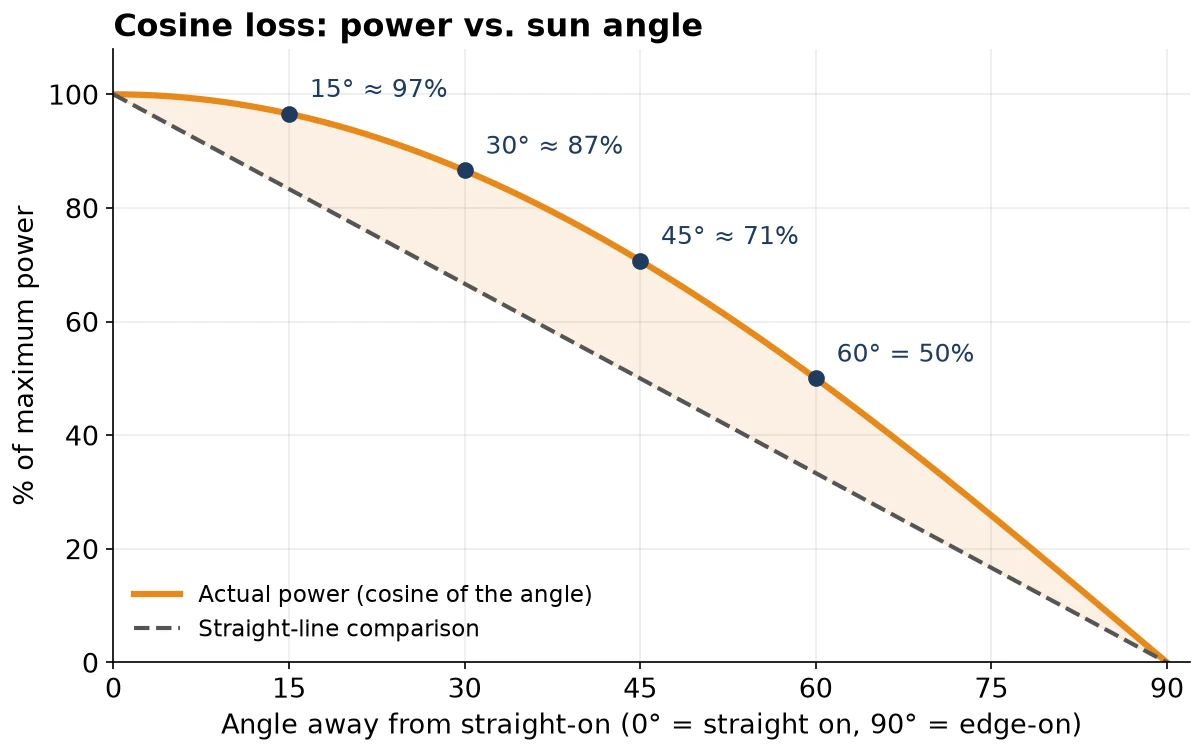
The curved line shows real cosine loss. The dashed straight line is there for comparison, and the gap between them shows how much power a panel holds onto even when the sun isn't straight on.
The good news is that cosine loss is gentle at first. When the sun is 30° away from straight on, the panel still gets about 87% of its full power. At 45° it gets about 71%, and at 60° it gets half. The loss only gets steep when sunlight is glancing across the glass, such as early morning, late afternoon and the short days of winter.
Two other things add to the loss when the sun is low. More light bounces off the glass at a glancing angle, although the anti-reflective coating on today's panels keeps that small until the angle gets quite steep. The sunlight also travels through more of the atmosphere before it arrives, which dims it.
The sun's path also changes a lot through the year. In Central and Eastern PA, the midday sun climbs to roughly 73° above the horizon in late June but only about 26° in late December. We can't move the sun, so we choose the tilt and direction of the panels to catch it well across the whole year. On ground mounts, a tracker that follows the sun can recover much of the daily cosine loss.
For a fixed system facing due south, the best year-round tilt across Pennsylvania works out to about 36 to 38 degrees, from the Maryland line up to the New York line. The difference is small near the top, so you're pretty safe anywhere from the upper 20s to the mid 40s, which is why most PA roofs are already close to ideal. If your roof doesn't face due south, the best tilt gets flatter the farther it turns. East- and west-facing roofs still produce solidly, just more in the morning or afternoon.
Temperature: panels like it cool
Solar panels are a bit like people working outdoors, since they do their best work when it's cool and sunny. As a panel heats up, its output drops slightly. Manufacturers list this as a temperature coefficient on every datasheet. Most of today's panels use n-type TOPCon cells, which are typically rated at about -0.29% to -0.30% per °C. That means they lose roughly three-tenths of a percent of their power for every degree Celsius above 25°C (77°F). Older PERC panels were typically rated around -0.34% per °C or worse, so newer panels hold up better in the heat.
Panels also run much hotter than the air around them. In full sun they are commonly 20°C or more above the air temperature, so on a hot summer afternoon the cells can be well above 60°C (140°F). That is why the heat penalty is real even when it doesn't feel extreme outside.
This explains something we see on our own systems. The single best production day of the year often comes in late April or early May, on a clear, cool day when the sun is already high. Summer brings high sun and long days, so production is consistently solid, but the heat tempers the peak. Winter output is lower because the days are short and the sun is low, though it doesn't fall off as much as you might expect, because cold panels and cool inverters work more efficiently.
Ground mounts tend to run cooler than roof mounts, because air moves freely under and around the panels. Many ground-mount systems also use bifacial panels, which collect some extra light on the back side from sunlight reflected off the ground. The gain depends on the site and the ground surface's reflectivity, called albedo, so we treat it as a bonus rather than something to count on.
Dirt, pollen, leaves and snow
A light, even layer of dust or pollen acts like a dim filter over the glass. In a climate like ours, regular rain usually washes most of it away, so the effect on most systems is small.
Spot buildup is a different story. A bird dropping or a wet leaf stuck over part of a panel behaves just like shade, triggering the same effect described above. Spots that sit for a long time can also create small hot spots on the cells, so it's worth getting them cleaned off.
Snow blocks the light completely while it covers the panels. Because the panels are tilted, dark and slick, they warm up as soon as some sunlight gets through, and the snow usually slides off in sheets once the weather breaks. After a snowfall, the bright white ground can even reflect a little extra light onto the panels, which helps bifacial panels in particular. Our ground mounts sit high enough to stay out of grass and weeds, which also leaves room for sliding snow to clear the panels.
Keeping your system performing
Fixed-tilt solar systems have no moving parts and are essentially maintenance free, but a little attention now and then helps. Our Service & Repair team can clean panels, clear debris and install critter guards to keep birds and squirrels from nesting under the array.
Wondering if shade or dirt is costing you production? Contact us and we'll take a look.

Have Questions? Call us at 877-345-2470
We want to ensure you are well-informed about our product line and how it can save you money on your monthly energy bills.